
Checking Criminal History in Litchfield County
No single query returns a complete Litchfield County criminal history. The Connecticut Judicial Branch criminal case hub separates pending cases, convictions, daily dockets, and motor vehicle matters. Court results show what prosecutors filed and what the Superior Court did. Police reports tell the earlier event story. The State Police Bureau of Identification, or SPBI, maintains the statewide repository, while the Connecticut Department of Correction covers current state custody and some supervision information.
Start with a full legal name and exact birth date. Keep former names and spelling variants close at hand. A docket number is better than a name when one is known. The following order moves from free public case data toward official copies and self-review products without treating any one source as complete.
- Choose the pending, conviction, or daily-docket tool that fits the question.
- Search the name and birth data, then narrow the result by court and status.
- Save the matching docket number, charge, court location, and disposition.
- Ask the arresting agency for releasable incident or arrest detail.
- Order a clerk copy or SPBI self-review when an official record is needed.
Erased, youthful-offender, juvenile, sealed, and other confidential matters do not appear as ordinary public results. A missing name is therefore not proof that no event occurred.
No Litchfield County Sheriff Records
Connecticut abolished county government, and Litchfield County has no elected sheriff’s criminal-records division. State marshals handle civil process, but they do not keep local arrest files. This is more than a naming point. A request sent to a made-up county sheriff cannot reach the right custodian.
Municipal police serve Torrington, New Milford, Watertown, Plymouth, Thomaston, and Winchester. Resident troopers and Connecticut State Police troops cover many other towns. Troop L operates from 452A Bantam Road in Litchfield at 860-626-7900. Troop B, at 463 Ashley Falls Road in North Canaan, can be reached at 860-824-2500. The Litchfield Judicial District agency roster helps identify the police custodian before a request is filed.
Judicial Branch courthouse information shows the modern court destination rather than the historic Litchfield courthouse.
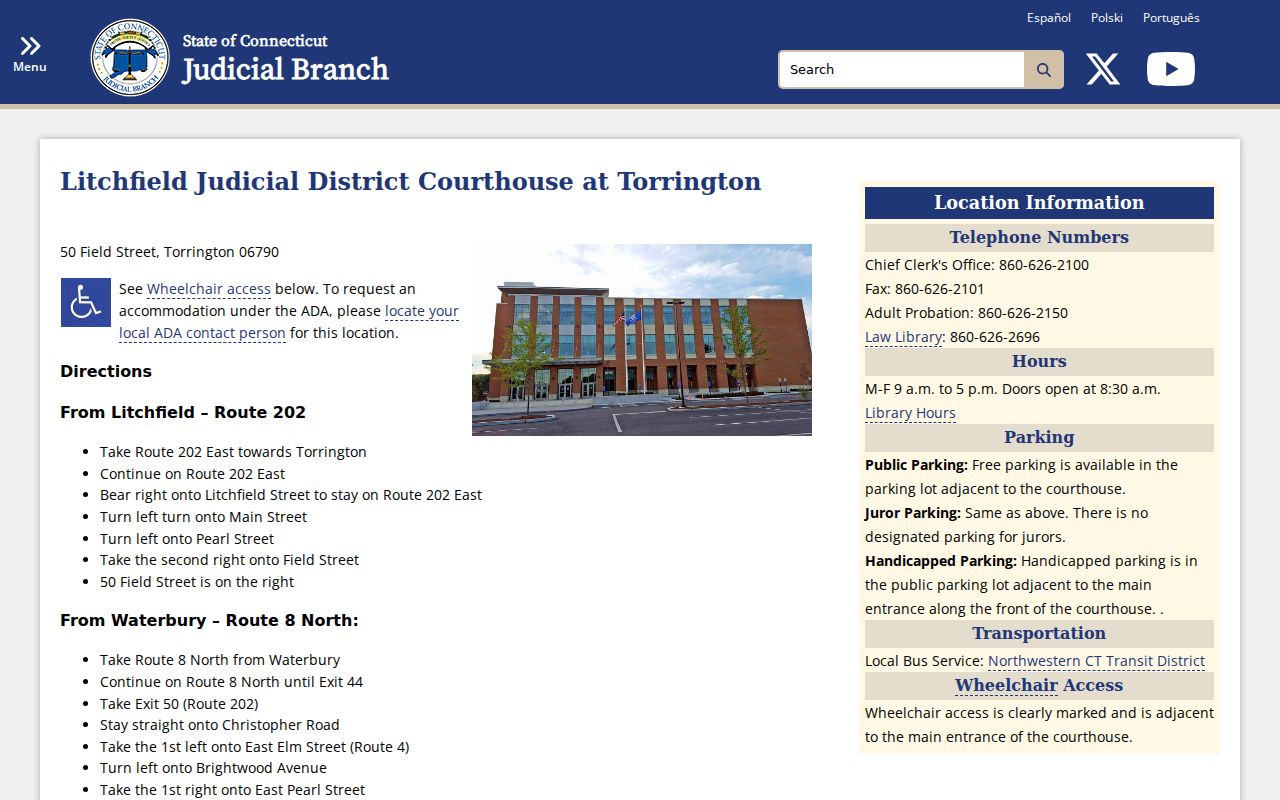
The source image marks the state courthouse channel that replaces the county-office model for filed criminal cases.
Connecticut Official Background Checks
The Connecticut Department of Emergency Services and Public Protection, Division of State Police, SPBI is the official repository. There is no general public instant name-search portal. For review of one’s own Connecticut record, follow the live SPBI instructions and the DESPP-0846-C process. CCHRS pre-enrollment is used only when an authorized program supplies a service code.
The product choice changes the result. A $36 name and date-of-birth search says only whether a Connecticut record exists. The $75 name-based conviction-history search provides a copy if a record exists. A fingerprint-based Connecticut conviction-history search costs $75, plus capture fees, and reduces false name matches. SPBI in Middletown offers appointment-only fingerprint capture for $15. Local departments set their own capture rules and fees.
| SPBI product | Fee | Result |
|---|---|---|
| Name/DOB existence search | $36 | Existence response only |
| Name/DOB conviction history | $75 | Copy when a match exists |
| Fingerprint conviction history | $75 | Fingerprint-supported state result |
| SPBI fingerprint capture | $15 | Appointment-only capture |
DESPP explains the State Police Bureau of Identification services shown in the next image.
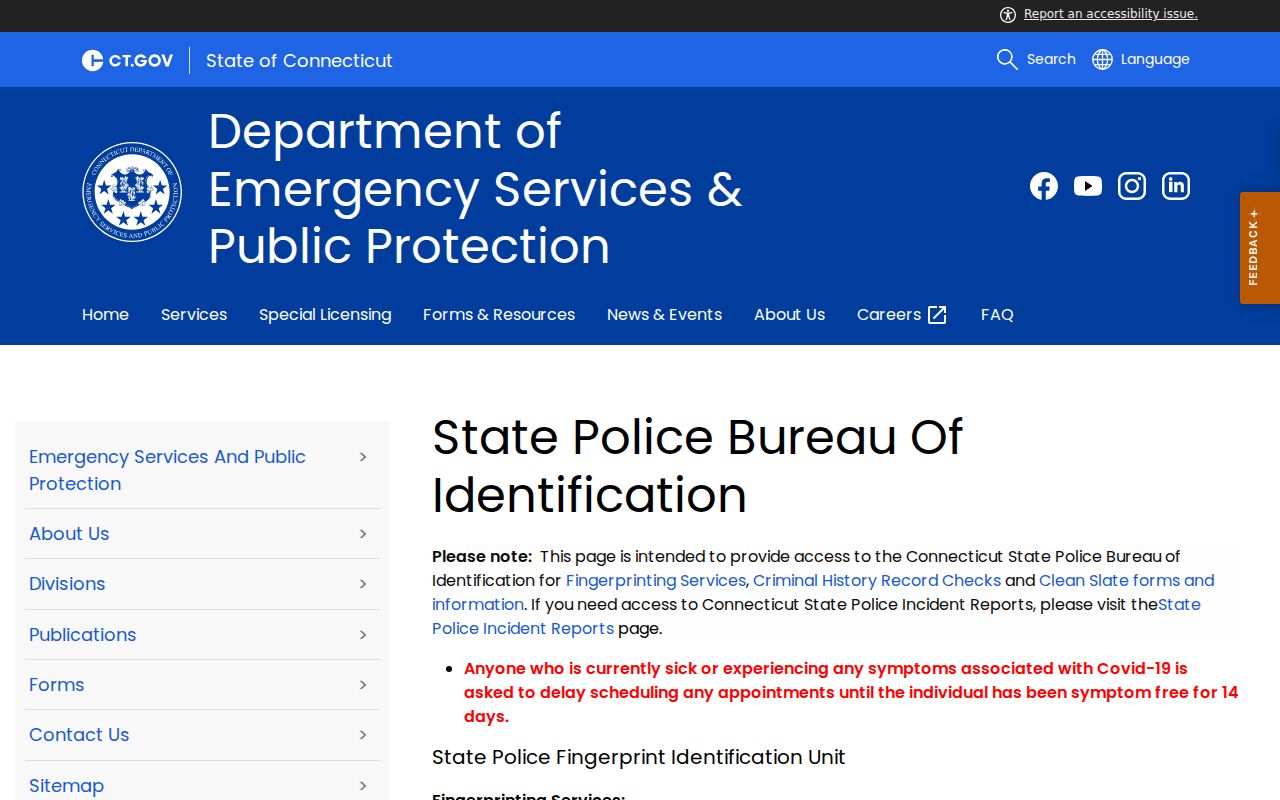
That official page should control if an older paper form conflicts with a current service-code workflow.
Four Litchfield County Record Systems
Court, police, SPBI, and correction records answer separate questions. A police report records allegations, officers, initial charges, and the incident narrative. The Superior Court file shows the charge that was actually filed, hearings, pleas, disposition, and sentence. SPBI links fingerprint-supported arrest cycles to reported outcomes. CT DOC begins a correction record only when a person enters state custody or a covered supervision status.
| Channel | Best use | Important limit |
|---|---|---|
| Judicial Branch | Filed case and disposition | Restricted cases are omitted |
| Police or troop | Incident and arrest report | Agency-specific request |
| SPBI | Statewide self-review | Repository data may contain gaps |
| CT DOC | Current state custody | Not a county booking log |
A sound Litchfield County criminal record check compares the channels instead of merging them. Initial arrest charges may be reduced, replaced, dismissed, or never filed. Older dispositions can also fail to link to an arrest cycle. The docket number is the best bridge between systems.
Criminal Record Types
Litchfield County criminal records form at different moments. The arresting agency creates an incident or arrest report and may also create a booking file. The prosecutor selects the charge to pursue. Connecticut Superior Court then creates the public case docket. SPBI receives fingerprint data and dispositions, and CT DOC records state custody. Probation belongs to the Judicial Branch Court Support Services Division, while parole supervision belongs to CT DOC Parole and Community Services.
- Arrest and booking records describe custody, initial charges, bond, fingerprints, and agency processing.
- Court case files show filed charges, appearances, motions, pleas, disposition, and sentence.
- Repository histories collect qualifying statewide arrest cycles and reported court outcomes.
- Warrant records may remain within police and court systems, with no complete public county search.
- Custody and registry entries cover distinct correction or statutory registration duties.
The dedicated Litchfield County arrest lookup follows agency, court, and custody channels without turning an arrest into proof of guilt.
Litchfield County Inmate Search
There is no Litchfield County jail roster. A person may spend a short time at a municipal police facility or State Police troop before release or transfer. For state custody, use the free CT DOC Offender Information Search. It accepts a DOC number or name and can be narrowed by birth date. The public locator is updated daily and includes certain accused or pretrial detainees as well as convicted people, but excludes Youthful Offender and ICE-held records.
For a very recent arrest, call the arresting department and check the Judicial Branch daily docket before relying on DOC. Once a facility appears, use that facility’s current visitation, mail, phone, and deposit rules. Do not address money or mail to a “Litchfield County Jail,” since no such jail exists.
The official CT DOC search is pictured below as the statewide custody channel.
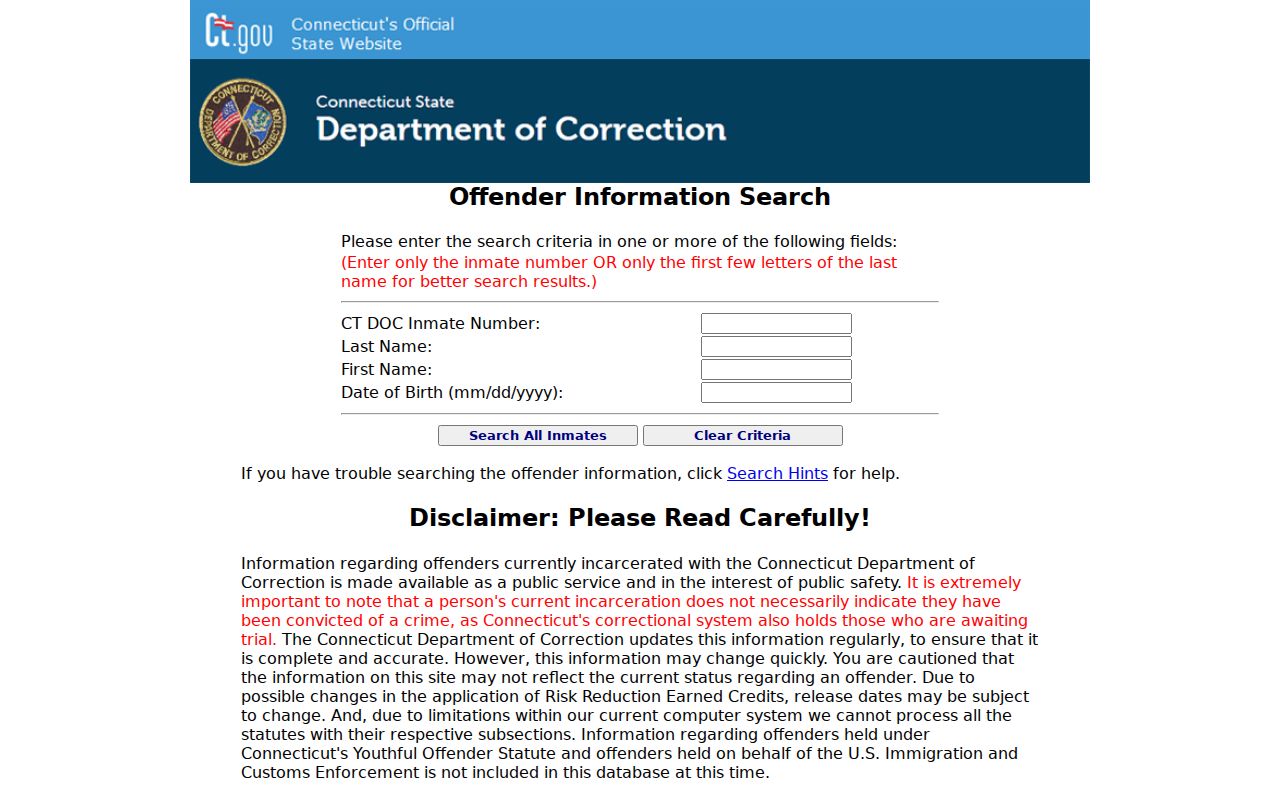
The locator adds custody context but does not replace a police report or court disposition.
Inside a Litchfield County Criminal Record
A rap sheet starts with identity data and then groups fingerprint-supported arrest cycles. A public court file focuses on the legal case. Booking data emphasizes intake and release. Reading the field labels in context prevents a police allegation from being mistaken for a judgment.
| Name and identifiers | Legal name, aliases, date of birth, and state or federal identifiers when lawfully shown. |
|---|---|
| Arrest and booking | Agency, incident number, arrest time, initial charge, bond, fingerprints, and custody events. |
| Charges and statutes | Police charges may differ from the counts filed by the State’s Attorney. |
| Disposition | Conviction, acquittal, dismissal, or nolle prosequi for each filed count. |
| Sentence | Incarceration, suspended time, probation, restitution, and other court orders where public. |
| Custody or supervision | DOC or docket status, with private officer notes and medical data withheld. |
“Nolle prosequi” means the prosecutor has declined to proceed on a charge. “Disposition” means the operative outcome. Neither label should be read without its date and the status of every count in the case.
Find Litchfield County Police Reports
First identify the agency that investigated. Two nearby incidents can belong to different custodians because troop and municipal borders matter more than the historic county line. State Police reports go through DESPP Reports and Records and GovQA. The search fee is $16 and is nonrefundable even if no report is found. A card payment may add a convenience charge. Free accident information summaries use the state accident channel, while investigative reports and certain crashes use GovQA.
Municipal records go to the involved department. Include contact information, incident number if known, date, place, involved parties, exact record type, delivery format, and certification need. Ask for segregable public portions when an active investigation, juvenile data, victim identity, witness safety, or an uncorroborated allegation requires redaction. Connecticut FOIA does not require a broad public-purpose explanation, but the request must describe the record well enough to find it.
Note: Litchfield County Dispatch is an emergency communications center, not the automatic custodian of every police investigative file.
Public Access Laws in Connecticut
The Connecticut Freedom of Information Act governs many executive and municipal records, while court-file access also follows Judicial Branch law and rules. The record must go to its real custodian. A police department cannot certify a court judgment, and the court clerk does not hold every police narrative.
Key Connecticut rules:
CGS §1-210 starts with public access and lists exemptions for protected law-enforcement and personal information.
CGS §1-212 governs copies, fees, certified copies, and electronic access.
CGS §29-10b authorizes the State Police report-search fee.
CGS §54-142a controls erasure of qualifying criminal records.
A municipal or state-agency FOIA denial may be appealed to the Connecticut Freedom of Information Commission within the governing period. Court records do not follow that executive-branch appeal route in the same way. Redaction of exempt details may permit the rest of a report to be released.
Resolve Litchfield County Warrant Records
Connecticut has no complete public Litchfield County active-warrant search. A pending docket may show a failure-to-appear or rearrest-warrant event once it is public, yet it is not a warrant-clearance certificate. Sealed warrants and unserved affidavits may stay confidential. Probation violations can create their own warrant and proceeding.
For one’s own possible warrant, use a careful fallback chain. Call the clerk for a known docket, identify the police agency or troop involved, and consult counsel before appearing if surrender may be required. After the matter is handled, confirm through the court record that the warrant was vacated. Unofficial name-search sites cannot prove active or cleared status.
Record flow: Court order › police execution › booking › arraignment › docket update › court resolution.
Sealed, Expunged, and Restricted Records
Juvenile and youthful-offender files are confidential. Public records also omit or redact Social Security numbers, account data, protected victim details, and other exempt information. Under Connecticut erasure law, qualifying nonconviction outcomes can be removed from ordinary police and court disclosure. A dismissed or nolled matter may not vanish from every system at the same moment.
Connecticut relief uses distinct terms. Statutory erasure covers qualifying outcomes under §54-142a. Clean Slate automates erasure of eligible convictions after the applicable conditions and wait. An Absolute Pardon can erase an adult Connecticut criminal record. A Certificate of Employability is separate and does not erase the record. Current eligibility and system status should be checked through official sources.
Connecticut’s Clean Slate program page provides current implementation information.
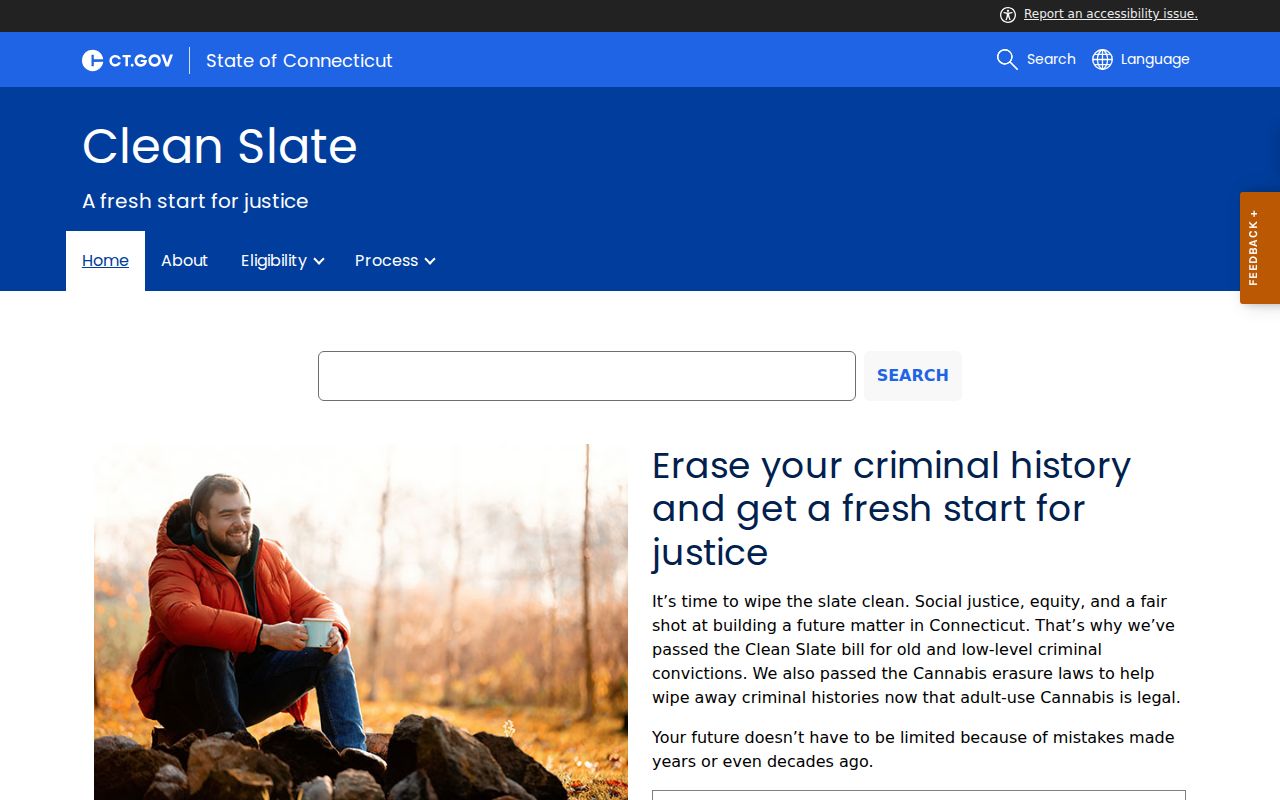
The image source distinguishes automatic Clean Slate work from case-specific statutory erasure and pardon relief.
Litchfield County Absolute Pardon Review
An Absolute Pardon is Board of Pardons and Paroles relief that results in erasure of an adult Connecticut criminal record. Pardon applicants follow the Board’s current document instructions, including a qualifying SPBI report and fingerprints. The Board directs applicants through an authorized CCHRS service code rather than treating CCHRS as a public name-search tool. The report must meet the Board’s current age requirement, and qualifying petitioners may use the published fee-waiver affidavit.
The Board’s Absolute Pardon FAQ is the source for the process illustrated below.
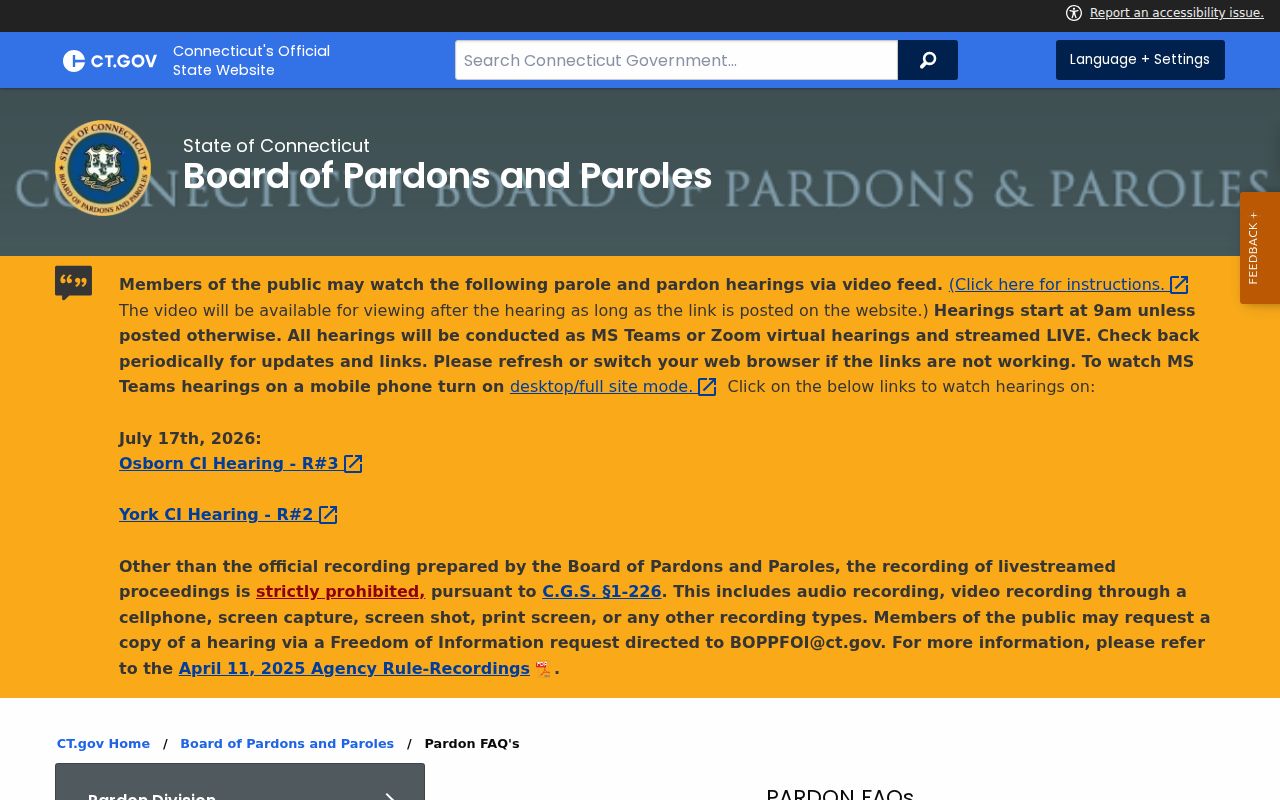
The official FAQ should be checked before ordering records because program steps can change.
Litchfield County Criminal Records by City
The largest Litchfield County municipalities have their own police custodians, even though criminal cases move into Connecticut Superior Court. Torrington is also the county’s modern judicial hub. New Milford has a municipal records unit and a large service area. Watertown police records route differently because filed cases are assigned to Waterbury JD/GA4. Each local route begins with the investigating agency, not a county sheriff.
Torrington Criminal Records
Police reports begin at the Records Division, while filed cases go to the Field Street clerk.
New Milford Criminal Records
Written police requests and local record checks use New Milford’s own municipal channels.
Watertown Criminal Records
Town police records stay local, while court cases route to the assigned state courthouse.
Torrington Criminal Records Hub
The Litchfield Judicial District Superior Court at 50 Field Street, Torrington, is the main public criminal-case building for the district. The Chief Clerk’s Office is 860-626-2100. Part A and Part B criminal clerk work was consolidated on the first floor in 2018. The State’s Attorney and probation functions are also based in Torrington, but each office has a different role. The clerk keeps public case files; the State’s Attorney prosecutes; CSSD supervises probation.
Call before travel when an older file may be at the Judicial Records Center. Visitors pass through court security. ADA accommodations and interpreter services follow Judicial Branch procedures. Watertown and Plymouth show why a historical county line cannot select every venue: their court assignments can fall outside the Litchfield Judicial District.
Litchfield County Criminal Case Classes
Connecticut Superior Court hears both felonies and misdemeanors. Part A generally carries the most serious criminal cases, while Part B handles other criminal matters. They are dockets within the same state trial court system, not separate county and municipal courts. Connecticut classifies felonies and misdemeanors as A, B, C, D, or unclassified. The specific offense statute still controls because special ranges and mandatory provisions can replace a general class rule.
- Part A
- The Superior Court docket that generally handles the most serious criminal matters.
- Part B
- The Superior Court docket for other criminal cases in the state system.
- Docket number
- The court’s unique case identifier and the best key for copy requests.
- Disposition
- The outcome assigned to each filed charge, not merely the case as a whole.
The filed charge and statute on the docket are more reliable for case status than the first charge printed in an arrest report.